
Witcher 3 Best Ways to Make Money (Farm Crowns Fast)
Witcher 3 best ways to make money: contracts and haggling, which merchants pay most, why merchants run out of crowns, dismantling, Gwent and what not to sell.


In this article (0 sections)
Updated September 29, 2026. The fastest reliable way to make money in The Witcher 3: Wild Hunt is not a single exploit. It is a routine: take every witcher contract and haggle, sell each item type to the merchant who specializes in it, do your big selling in Novigrad and Toussaint rather than villages, and dismantle jewelry and junk before you dump it. On top of that, a handful of one-off side activities, like the High Stakes Gwent tournament, fistfights and horse races, add solid lump sums.
Quick answer
Witcher contracts with haggling are the best steady income. Sell weapons to blacksmiths, armor to armorers and junk to general merchants and innkeepers, preferably in Novigrad or Toussaint. Merchants have a limited crown supply that refills after about five in-game days, so meditate and come back. Corvo Bianco does not generate passive income in the unmodded game; it costs crowns to renovate.
This guide sticks to methods that work in the current version of the game. We only quote crown figures where a walkthrough or wiki lists them, and we flag anything that comes from player reports rather than documented quest data. If you are just starting out, pair this with our Witcher 3 beginner's guide, because early money habits matter more than late-game farming.
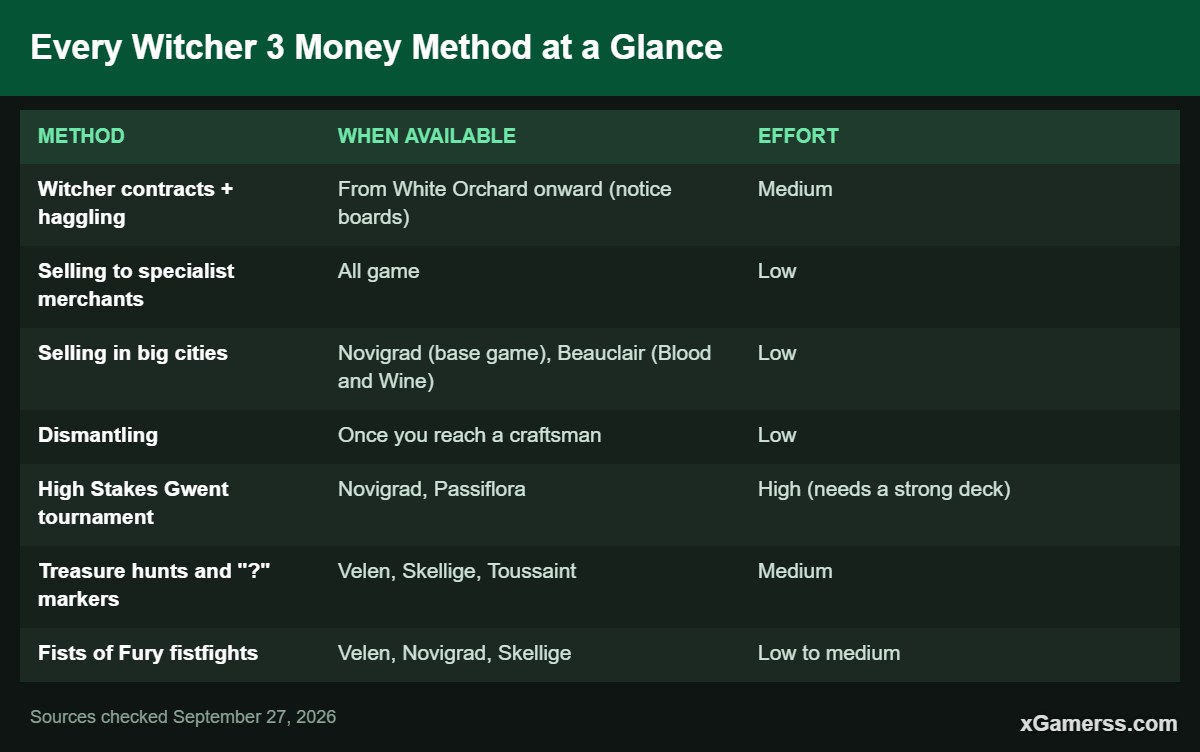
Every Witcher 3 Money Method at a Glance
Here is the short version before we go through each method. "Effort" is a rough judgment of how much time and attention the method takes, not a measured rate.
| Method | When available | Effort | Notes |
|---|---|---|---|
| Witcher contracts + haggling | From White Orchard onward (notice boards) | Medium | Best steady income; push the haggle bar but not to the limit |
| Selling to specialist merchants | All game | Low | Weapons to blacksmiths, armor to armorers, junk to merchants/innkeepers |
| Selling in big cities | Novigrad (base game), Beauclair (Blood and Wine) | Low | City vendors generally pay more and hold more crowns than village traders |
| Dismantling | Once you reach a craftsman | Low | Costs a fee; worth it for jewelry and items holding valuable parts |
| High Stakes Gwent tournament | Novigrad, Passiflora | High (needs a strong deck) | 1,000 crown entry; 4,500 crown prize recovered after the theft |
| Treasure hunts and "?" markers | Velen, Skellige, Toussaint | Medium | Crowns in chests plus gear to sell or dismantle |
| Fists of Fury fistfights | Velen, Novigrad, Skellige | Low to medium | One-time purses and bets; Novigrad bouts pay up to 240 crowns each |
| Horse races | Velen, Novigrad, Skellige | Medium | Small purse plus your wager back; best rewards are horse gear |
| Corvo Bianco vineyard | Blood and Wine | n/a | No passive income in the unmodded game; renovations cost crowns |
Witcher Contracts and Haggling: The Best Steady Income
Witcher contracts are the backbone of Geralt's income. You find them on notice boards, accept the job from the client, and collect a lump sum after the monster is dead. The fight also drops monster parts and a trophy, and trophies can sell for a lot to the right buyer.
How haggling works
When a client names a price, you can move a slider to ask for more. The client's annoyance bar grows the higher you push. Keep it out of the red and you usually get a better offer. Max it out and, as experienced players on GameFAQs describe it, the client simply reverts to the original offer. You lose the bonus, not the contract.
A practical approach:
- Push the slider until the bar turns noticeably angry, then pull it back a little before confirming.
- If you are unsure, save before talking to the client. Accepted amounts vary, so reloading is not a guarantee.
- Haggling costs nothing and takes seconds, so do it on every contract.
Contracts reward good combat more than anything else. If higher-level monsters are giving you trouble, our Witcher 3 combat tips for beginners will get you through them faster.
Sell to the Right Merchant (and in the Right City)
This is the easiest upgrade to your income, and most players ignore it. The Witcher 3 does not pay the same price everywhere. Two things matter: what kind of merchant you are selling to, and where they are.
Match the item to the merchant type
- Weapons sell best to blacksmiths.
- Armor sells best to armorers.
- Junk (tools, trinkets, household items) sells best to general merchants and innkeepers. The Witcher Wiki notes that general merchants buy junk at higher prices than other shopkeepers.
- Food and drink go to innkeepers.
- Alchemy items go to herbalists and alchemists, although you should keep most ingredients (see below).
Sell in Novigrad and Toussaint, not villages
The Fextralife wiki states that vendors in big cities usually offer a higher rate and that merchants in Novigrad usually have a larger crown supply. In the base game, that means Novigrad and Oxenfurt. With Blood and Wine installed, Beauclair in Toussaint is the other major market, and several guides rank Toussaint alongside Novigrad as the best place to sell. Some guides also report that Skellige merchants pay noticeably less, but we could not confirm exact figures, so treat that as a tendency, not a rule.
Players regularly single out Hattori, the master swordsmith in Novigrad, and the armorer in Hierarch Square for their deep crown reserves. Both are worth a stop whenever you are carrying a stack of gear.
The Hugo tip in Toussaint (community-reported)
In Blood and Wine, resolving the side quest Father Knows Worst peacefully (talking Hugo's brothers down instead of fighting them) turns Hugo into a merchant at The Clever Clogs in Beauclair, where he sells drinks at reduced prices. A popular Steam community guide says he also buys items at full price but only carries a small crown supply. The discount is documented on the wiki; the full-price buying is based on player reports, so check it in your own game before relying on it.
Why Merchants Run Out of Crowns
Every merchant has a finite amount of money, and it is shown in the trade menu. Once it is gone, they cannot buy anything else from you, no matter how valuable it is. This catches out a lot of players who save up a huge haul and then try to sell it all in one shop.
The fix is simple:
- Spread your big sales across several vendors in the same city.
- When they are all tapped out, meditate. According to the Fextralife wiki, a merchant's supply replenishes after five in-game days.
- Come back and sell the rest.
This is why city merchants matter so much. They not only pay better, they also start with more cash, so you need fewer trips.
Dismantling: When Parts Are Worth More Than the Item
Craftsmen can dismantle items into crafting components for a fee. Some items are worth more as parts than whole, which is especially true of jewelry. Pearl necklaces and pieces containing precious metals or gems break down into components that sell well or feed directly into high-end crafting.
Two rules keep dismantling profitable:
- Use a master-level craftsman or better. Guides note that master craftsmen always extract the full amount of components. Yoana, the master armorer at Crow's Perch, is a convenient early option.
- Do the math first. A ladle is still a ladle. Compare the item's sale value with its components in the dismantle menu before paying the fee.
Components from dismantling are also what you need for witcher gear. If you are chasing school sets, our Witcher 3 school armor guide shows what each set requires.
Gwent, Fistfights and Horse Races
These side activities are one-time or limited sources, not farms. Still, they add up and several are fun in their own right.
High Stakes Gwent tournament
The standout Gwent payday is the High Stakes tournament at the Passiflora in Novigrad. The entry fee is 1,000 crowns. After you win, thieves steal the purse, and you track them down with Sasha to recover the 4,500 crown prize. You also win unique leader cards, but only from the players you actually beat, so win every match. Build a strong deck before you pay the entry fee.
Fists of Fury
Fistfighting quests pay a small purse per opponent plus bets. In Fists of Fury: Novigrad, GameBanshee's walkthrough lists rewards of up to 100 crowns for Archibald O'Neill, up to 160 for Georgius "Piledriver" Georg, up to 190 for Captain Mortimer and up to 240 for Durden the Tailor, the champion. Skellige and Velen have their own fistfight chains.
Horse races
There are races in Velen, Novigrad and Skellige. At Crow's Perch, GameBanshee lists purses of 20, 30 and 40 crowns plus whatever you wager, and the real prizes are horse gear: a racing saddle, saddlebags and blinders. Race for the gear and the wagers, not for the base purses.
Treasure Hunts and Question Marks
Treasure hunts and the "?" markers across Velen, Skellige and Toussaint are a good way to combine money with exploration. Bandit camps, monster nests and hidden caches drop crowns, sellable loot and often weapon or armor diagrams. Guarded treasure in Skellige, including smugglers' caches along the coast, is especially common.
The key is what you do with the loot afterwards. Sell duplicate weapons and armor to specialist merchants, dismantle jewelry, and keep diagrams and relic-grade gear you might actually use. Late-game standouts like Aerondight come from quests, but a lot of good mid-game gear comes straight from treasure hunts.
Corvo Bianco: A Home, Not a Money Maker
This is one of the most common misconceptions about Blood and Wine. Geralt gets his own vineyard estate, Corvo Bianco, and many players assume it produces wine income. In the unmodded game, it does not. Players who asked this directly on GameFAQs got the same answer: no gold generation.
Instead, Corvo Bianco is a crown sink. Gamepressure's guide lists the general renovation at 5,000 crowns, with additional upgrades such as an armorer's table and grindstone at 1,000 crowns each, and other renovations ranging from 500 to 2,000 crowns. What you get in return is practical rather than financial: sleeping in the renovated bed grants a temporary vitality bonus, the stable gives Roach an endurance bonus, and the garden lets you grow rare herbs. PC players who want real vineyard income can look at Nexus mods that add wine sales; see our guide on how to install Witcher 3 mods.
What Not to Sell
Money in The Witcher 3 is easy to earn back. Rare materials are not. Avoid these common mistakes:
- Crafting components sell for little but cost a lot to buy back from craftsmen.
- Rare materials like dimeritium and high-end metals are required for top-tier witcher gear.
- Alchemy ingredients: keep a reserve so you can refill potions and craft upgrades.
- Weapons and armor you might upgrade, including early witcher school pieces.
- Quest items, which are usually worth nothing to merchants anyway.
Also check your Novigrad orens and Nilfgaardian florens. Merchants do not treat them as crowns, but the banks exchange them: Vimme Vivaldi in Novigrad and Giacomo Cianfanelli in Beauclair. Finally, if you just want money for testing a build and do not care about playing it straight, PC players can use Witcher 3 console commands to add crowns instantly.
Frequently Asked Questions
QWhat is the fastest way to make money in Witcher 3?
Doing witcher contracts with haggling, then selling the loot to specialist merchants in Novigrad or Toussaint. For a single large payout, the High Stakes Gwent tournament returns 4,500 crowns on a 1,000 crown entry.
QHow long until merchants get their crowns back?
About five in-game days. Meditating is the quickest way to pass the time, then return and sell the rest of your haul.
QDoes Corvo Bianco make money in Witcher 3?
No. In the unmodded game the vineyard produces no income. Renovations cost crowns and give buffs, crafting stations and a herb garden instead.
QWhat happens if you haggle too much on a contract?
If you fill the client's annoyance bar, they fall back to their original offer. You keep the contract; you just lose the extra.
QWhere is the best place to sell items in Witcher 3?
Big-city merchants pay more and carry more crowns. Novigrad (including Hattori and the Hierarch Square armorer) is the best base-game market; Beauclair in Toussaint is the main alternative in Blood and Wine.
Money-making habits carry over to every version of the game, including the Witcher 3 Remastered update. For more guides, visit our Witcher 3 hub.
Sources checked on September 29, 2026 against the Witcher Wiki, the Fextralife Witcher 3 wiki, GameBanshee and Gamer Guides walkthroughs, Gamepressure's Blood and Wine guide, and Steam and GameFAQs community discussions.
Kai Mercer covers game news, free games, release calendars and guides for xGamerss.
More from Kai Mercer →
Comments (0)
No comments yet. Be the first!
Sign in or create an account to earn karma — or comment as a guest.