
Witcher 3 Oils Guide: Best Blade Oil for Every Monster Type
Witcher 3 oils guide: which blade oil to use on every monster type, tier bonuses and charges, Poisoned Blades and Fixative skills, and formula locations.


In this article (0 sections)
Updated September 29, 2026. In The Witcher 3, the best blade oil is always the one that matches the enemy's category: Necrophage Oil for drowners and ghouls, Specter Oil for wraiths, Hanged Man's Venom for human bandits, and so on through twelve oil lines. This guide maps every monster type to its oil, explains tiers and charges, covers the Alchemy skills that make oils stronger, and lists where to find each formula.
Quick answer
There are 12 oil lines, one per enemy category, each in base, Enhanced and Superior versions giving +10%, +25% and +50% attack power against that category. Base oils last 20 hits, Enhanced 40 and Superior 60, and the bottle is never used up. Max out Fixative in the Alchemy tree and oils stop wearing off altogether.
How Oils Work in The Witcher 3
Oils are sword coatings. You craft an oil once, then apply it to your steel or silver sword from the inventory. While it is active, every hit against the matching enemy category deals extra damage. Against anything else, the oil does nothing.
Each sword holds one oil at a time under normal rules. That means you can keep, say, Hanged Man's Venom on your steel sword for bandits and Necrophage Oil on your silver sword for drowners without swapping anything.
Charges, not a timer
Applied oils do not expire on a clock. They wear off after a set number of hits. Once the charges hit zero, the coating is gone and you need to reapply.
The important detail is that the oil item itself is not consumed. Unlike bombs and potions, an oil bottle never needs refilling through meditation, so you can reapply as many times as you like. The only real cost is the few seconds spent in the menu.

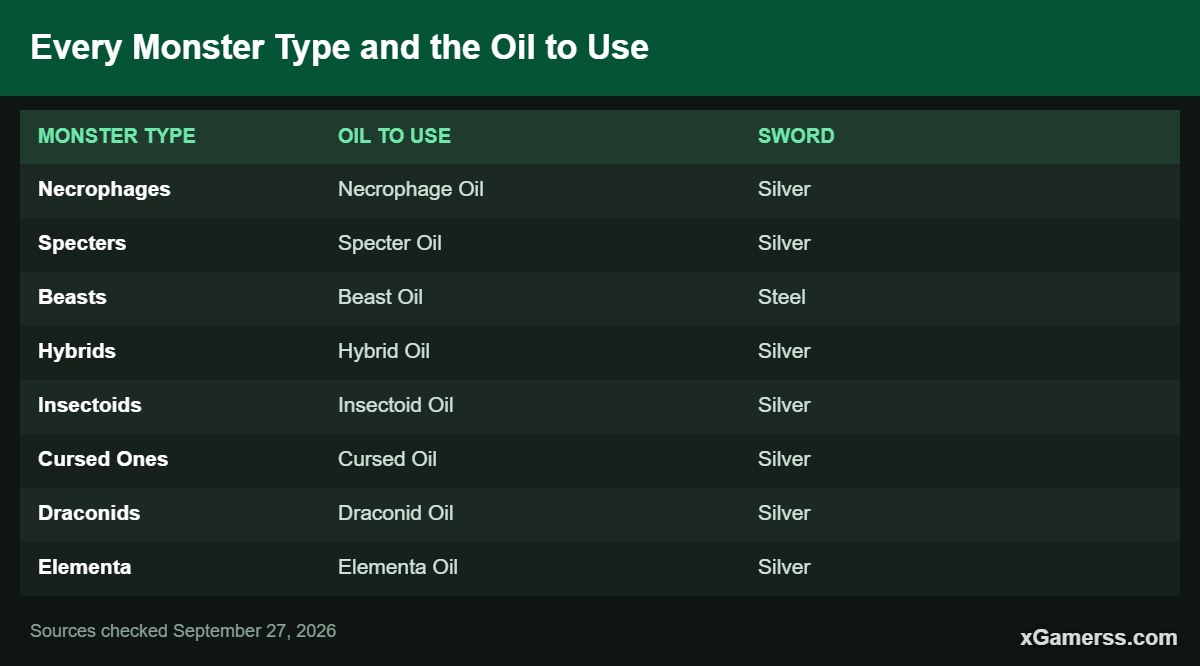
Every Monster Type and the Oil to Use
This is the table to bookmark. Beasts and humans are fought with the steel sword; everything else on this list calls for silver. Put the oil on the sword you will actually swing.
| Monster type | Oil to use | Sword | Example enemies |
|---|---|---|---|
| Necrophages | Necrophage Oil | Silver | Drowners, Ghouls, Alghouls, Rotfiends, Foglets, Water Hags, Grave Hags, Devourers, Drowned Dead |
| Specters | Specter Oil | Silver | Wraiths, Nightwraiths, Noonwraiths, Plague Maiden, Barghests, Beann'shie, Hym, Umbra |
| Beasts | Beast Oil | Steel | Wolves, Alpha Wolves, Wild Dogs, Bears, White Bears, Wild Boars, Panthers |
| Hybrids | Hybrid Oil | Silver | Griffins, Archgriffins, Harpies, Sirens, Erynias, Lamias, Succubi |
| Insectoids | Insectoid Oil | Silver | Endregas, Arachas, Kikimores, Giant Centipedes, Arachnomorphs, Pale Widow |
| Cursed Ones | Cursed Oil | Silver | Werewolves, Botchlings, Bear Berserkers, Ulfhedinn, Archespores |
| Draconids | Draconid Oil | Silver | Wyverns, Forktails, Basilisks, Cockatrices, Slyzards |
| Elementa | Elementa Oil | Silver | Earth, Fire and Ice Elementals, Golems, Gargoyles, Hounds of the Wild Hunt |
| Ogroids | Ogroid Oil | Silver | Nekkers, Nekker Warriors, Rock Trolls, Ice Trolls, Cyclopses, Ice Giants |
| Relicts | Relict Oil | Silver | Leshens, Ancient Leshens, Fiends, Chorts, Sylvans, Dopplers, Shaelmaars |
| Vampires | Vampire Oil | Silver | Katakans, Ekimmaras, Alps, Bruxae, Garkains, Fleders, Higher Vampires |
| Humans and nonhumans | Hanged Man's Venom | Steel | Bandits, soldiers, pirates, cultists and other human or nonhuman fighters |
Want the blade to match the oil? See our guide to the best steel and silver swords in The Witcher 3, including the Aerondight silver sword.
What each monster type looks like
Screenshots from our Witcher 3 walkthroughs, one per monster family, with the oil to apply.
A few categories trip people up. Werewolves are Cursed Ones, not Beasts, so Beast Oil does nothing to them. Nekkers look like small animals but are Ogroids. Wild Hunt hounds count as Elementa, and Fiends and Leshens are Relicts rather than Beasts. When in doubt, check the monster's Bestiary entry before the fight.
Oil Tiers: Base, Enhanced and Superior
Every oil line comes in three versions, and each tier needs its own formula. The Enhanced and Superior versions are labeled as such in your crafting menu, for example Enhanced Necrophage Oil and Superior Necrophage Oil.
| Tier | Attack power bonus vs. target type | Charges (hits) |
|---|---|---|
| Base (e.g. Necrophage Oil) | +10% | 20 |
| Enhanced (e.g. Enhanced Necrophage Oil) | +25% | 40 |
| Superior (e.g. Superior Necrophage Oil) | +50% | 60 |
The jump from base to Superior is big: five times the damage bonus and triple the charges. For a tough fight such as a high-level contract or a relict boss, getting the Superior version of that one oil is often worth more than a small sword upgrade.
Which oils to upgrade first
- Necrophage Oil gets the most use. Drowners, ghouls and hags fill Velen and Novigrad's riverbanks.
- Hanged Man's Venom is the go-to for bandit camps, deserters and Skellige pirates.
- Specter Oil pays off quickly, since several early contracts involve wraiths.
- Beast Oil is useful early for wolf packs, especially on higher difficulties.
Everything else can wait until you take a contract that needs it.

Alchemy Skills That Boost Oils
The Alchemy tree has an oil branch with four skills worth knowing. Two of them, Poisoned Blades and Protective Coating, were named in your search, and both only work when the oil on your blade matches the enemy.
Poisoned Blades (5 levels)
With an oiled sword, each hit has a chance to poison the target: 3% per skill level, reaching 15% at level 5. Poison adds damage over time on top of the oil's attack power bonus. It is a decent pick for an alchemy build but not an essential first unlock.
Protective Coating (5 levels)
This turns your oil into a defensive tool. It grants protection against attacks from the monster type your current oil targets, starting at 5% at level 1 and rising by 5% per level to 25% at level 5. Community guides note this stacks with your armor's resistances rather than replacing them.
Fixative (3 levels)
Fixative is the quality-of-life skill. Level 1 gives oils 33% more charges, level 2 67% more, and at level 3 oils no longer wear off. If you hate reapplying oils mid-contract, this is the skill to take.
Hunter Instinct (5 levels)
When your adrenaline points are full, Hunter Instinct raises your critical hit chance against enemies weak to your current oil. It suits builds that bank adrenaline during fights. For how these picks fit around core combat skills, see our best early Witcher 3 skills.
How to Apply and Switch Oils
Applying an oil is simple, and you can do it at any time outside of a cutscene.
- Open the inventory and find the oil in your alchemy items.
- Apply it to the steel or silver sword. The new oil replaces whatever was on that blade.
- Check the sword's tooltip for the active oil and remaining charges.
Quick slots
Oils can also be placed in your consumable quick slots so you can swap mid-fight without digging through the inventory. Most players reserve those slots for potions and bombs, though, since those matter more in the moment.
Auto-apply oils (patch 4.03)
CD PROJEKT RED's patch 4.03 notes list an added "option to auto-apply oils in combat." With it enabled, Geralt coats his blade with a matching oil when a fight starts, as long as you already own that oil. It removes the menu trip but not the need to craft or find the oils first.
Grandmaster Wolven gear
Blood and Wine's Grandmaster Wolven set raises the one-oil limit, letting you apply up to three oils to a blade at once according to catalog guides. That is handy for mixed fights where different monster types show up together. For more on that gear line, see our witcher school gear guide.


Where to Get Oil Formulas
You start the game with the base Necrophage Oil and Specter Oil formulas. Most other base formulas come from one person: Keira Metz, whose hut stands northeast of Midcopse in Velen. Her cellar also holds the base Hanged Man's Venom formula.
For Enhanced versions, the key vendor is Gremist at the Druids' Camp on Ard Skellig, who sells several Enhanced formulas. Superior formulas are mostly scattered as loot in specific locations or random drops.
| Oil | Base formula | Enhanced formula | Superior formula |
|---|---|---|---|
| Necrophage Oil | Starting inventory | Random loot | Elven ruins near Byways, Velen |
| Specter Oil | Starting inventory | Random loot | Guarded treasure near Kaer Morhen (wyverns) |
| Cursed Oil | Herbalist Tomira, White Orchard | Herbalist near Oxenfurt | Novigrad sewers during "Now or Never" |
| Beast Oil | Keira Metz, near Midcopse | Shopkeeper, Electors' Square, Novigrad | Small isle southwest of Fyke Isle |
| Hybrid Oil | Keira Metz | Random loot | Tied to the quest "A Greedy God" |
| Elementa Oil | Keira Metz | Shopkeeper, Electors' Square | Crach an Craite's chest, Kaer Trolde |
| Insectoid Oil | Keira Metz | Gremist, Druids' Camp (Ard Skellig) | Random loot |
| Vampire Oil | Keira Metz | Gremist, Druids' Camp | Location varies by guide (see note) |
| Draconid Oil | Keira Metz | Rannvaig alchemist (Ard Skellig) | Location varies by guide (see note) |
| Ogroid Oil | Rannvaig alchemist | Gremist, Druids' Camp | Random loot |
| Relict Oil | Random loot | Gremist, Druids' Camp | Random loot |
| Hanged Man's Venom | Keira Metz's cellar | Random loot | Random loot |
Note: Location guides disagree on where the Superior Draconid and Superior Vampire Oil formulas are placed, and several formulas are random loot, so treat this table as a starting point rather than a guarantee. Because most formulas can also drop at random, few of them are truly missable.
Tomira, the White Orchard herbalist who gives you the base Cursed Oil formula, also sells alchemy bases such as Fifth Essence early on.

Practical Tips for Using Oils Well
- Read the contract first. Contract investigations usually reveal what you are hunting. Prep the matching oil before the fight, not during it.
- Keep both swords oiled. Steel with Hanged Man's Venom and silver with the local monster oil covers most random encounters in one region.
- Do not oil for trash fights. A single drowner does not justify a menu trip; a nest or a contract boss does.
- Pair oils with signs and bombs. Oils boost your sword damage; the Bestiary also lists which signs and bombs work. Stack both for tough fights.
- Superior oil beats grinding. If a boss outlevels you, upgrading that one oil can close the gap faster than hunting for a new sword.
Oils only help if you land hits, so fundamentals still matter. Our guides to parrying and counterattacking and combat tips for beginners cover that side. If you just want to test builds, the Witcher 3 console commands on PC let you spawn items for testing.
Frequently Asked Questions
QWhat is the best oil in The Witcher 3?
There is no single best oil, because each one only boosts damage against its own monster category. The most-used early oils are Necrophage Oil (drowners and ghouls are everywhere) and Hanged Man's Venom for bandit-heavy areas. Later, whichever oil matches the contract you are on is the right one.
QDo oils run out in The Witcher 3?
The oil on your blade does. Base oils last 20 hits, Enhanced 40 and Superior 60. The bottle itself is not consumed, so you can reapply as often as you like. Maxing the Fixative skill (level 3) makes applied oils stop wearing off entirely.
QCan you use two oils at once?
Normally one oil per sword, so you can run one on steel and one on silver. Guides note that the Grandmaster Wolven set from Blood and Wine raises this to up to three oils on a blade.
QWhich oil do I use on werewolves?
Werewolves are Cursed Ones, so use Cursed Oil on your silver sword. The same oil works on Botchlings and Bear Berserkers.
QHow do I know which oil a monster is weak to?
Open the Bestiary entry for the monster (Glossary menu). Once Geralt has learned about the creature, its entry lists what it is susceptible to, and the category tells you which oil to use.
QIs auto-apply oils worth turning on?
If you find oil management tedious, yes. Patch 4.03 added an option to auto-apply oils in combat, which coats your blade with a matching oil you already own. Purists may prefer to prep manually, but it does not change damage numbers.
Sources checked on September 29, 2026 against CD PROJEKT RED's official patch 4.03 notes, the Witcher Wiki, and established Witcher 3 guides (Game8, Vulkk, Game Checklists, SegmentNext).
Kai Mercer covers game news, free games, release calendars and guides for xGamerss.
More from Kai Mercer →
Comments (0)
No comments yet. Be the first!
Sign in or create an account to earn karma — or comment as a guest.