
Witcher 3 Dodge vs Roll: Which Is Better and When to Use Each
Witcher 3 dodge vs roll explained: controls for PC, PlayStation, Xbox and Switch, when a sidestep beats a roll, stamina, Fleet Footed and common mistakes.
In this article (0 sections)
Updated September 27, 2026. In The Witcher 3, the dodge (a short sidestep or backstep) is the move you should use most of the time, and the roll is a longer escape you save for attacks that cover a lot of ground. Dodging keeps Geralt close enough to punish the enemy; rolling gets him out of danger but usually out of sword range too. Below is how each move works, the buttons on every platform, and a simple situation-by-situation table.
Quick answer
Dodge is better in most fights, especially against humans and anything attacking at close range, because it keeps you in position to counter. Roll is better against large monsters, area attacks and long charges, where a sidestep simply does not move you far enough. Default buttons: dodge is Left Alt (PC), Circle (PlayStation) or B (Xbox); roll is Space, Cross or A.
Dodge and Roll Controls on Every Platform
Both moves are combat-only actions. Outside combat, the same buttons handle things like jumping, interacting and sprinting. You can add a direction with the movement keys or left stick to choose where Geralt goes; without a direction he evades on his own default path.
| Platform | Dodge (sidestep) | Roll |
|---|---|---|
| PC (keyboard) | Left Alt + direction, or double-tap W/A/S/D | Space + direction |
| PlayStation | Circle + left stick | Cross + left stick |
| Xbox | B + left stick | A + left stick |
| Nintendo Switch | B + left stick | A + left stick |
These are the default layouts. Keybindings can be changed in the options menu on PC, so if you have remapped anything, check the controls screen rather than trusting a chart. On controller, note that the roll button is also the sprint and interact button, which is one reason players roll by accident when they meant to run.
How the Dodge Works
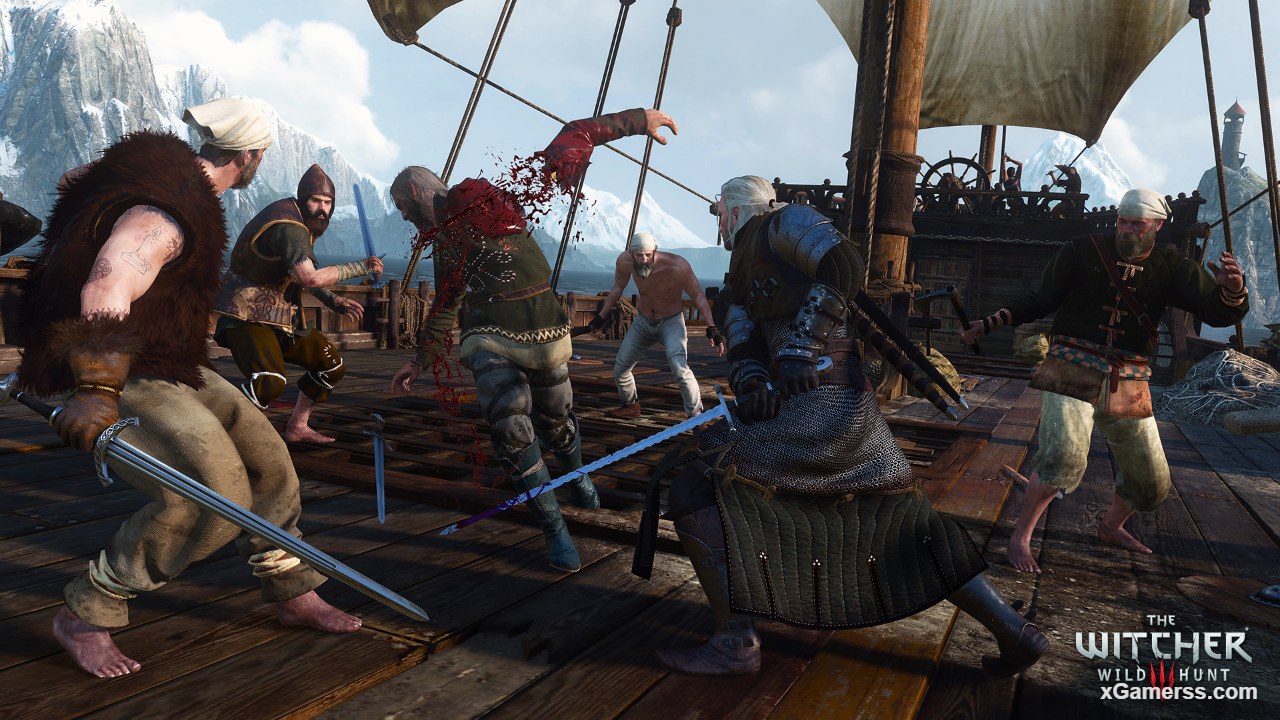
The dodge is a quick, short step to the side or backwards. It covers very little ground, which is exactly the point: Geralt stays near the enemy, and once the swing or bite whiffs, he is already in range to hit back. Most established guides treat it as the default defensive move against both humans and monsters.
It is worth understanding that the dodge is not a pure "invulnerability window" button. A detailed breakdown of the game's vanilla scripts by modder wghost81 explains that dodging works on direction relative to the attack: if you dodge roughly toward the attacker, the hit can still land, while dodging away from that danger zone keeps you safe. In practice that means:
- Sidestep across an attack (left or right), not into it.
- Against a forward lunge, a sideways dodge is usually safer than a straight backstep.
- Timing still matters: dodge as the attack starts to come in, not the moment an enemy raises its weapon.
How the Roll Works
The roll is Geralt's long-distance evade. It carries him noticeably farther than a dodge, which makes it the tool for repositioning and for leaving an area that is about to be covered by an attack. The trade-off, as TheGamer puts it, is that rolling "sacrifices possible openings for attacks after evading the enemy," because you end up too far away to punish.
Two other details are commonly cited:
- Stamina recovery: In the unmodded game, dodging and rolling do not spend stamina the way Signs do. However, guides from TheGamer and ConsolePulse both note that rolling halts or interrupts stamina regeneration, so constant rolling leaves you short of stamina for Quen or Aard.
- Stagger immunity: According to wghost81's script analysis, while rolling Geralt does not play a hit reaction and is protected from knockdown and stagger effects, even if damage still gets through. Treat that as a safety net, not a reason to roll through attacks.
When Dodge Is the Better Choice
Human enemies and duels
Bandits, soldiers and other swordsmen attack in quick, close-range combos. A short sidestep keeps you inside their reach so you can answer with a few fast attacks, which is the core loop recommended by most beginner guides: wait for the attack, sidestep, then strike two or three times. Against humans with shields or tight guards, pair this with parrying; our Witcher 3 parry and counterattack guide covers timing.
Close-range monster attacks
Claws, bites and lunges from drowners, ghouls, wolves and similar monsters have narrow hitboxes. A dodge to the side is enough to clear them, and it leaves you positioned to hit the monster's flank.
Keeping counter pressure
If you are playing an aggressive, fast-attack build, every roll resets the fight to neutral. Dodging keeps the pressure on, keeps stamina recovering, and keeps you ready for your next opening.
When Roll Is the Better Choice
Large monsters
Big creatures such as griffins and wyverns swing wide and dive from a distance. TheGamer specifically points to these fights as the place where rolling earns its keep, because the extra distance is what gets you out of the way.
Area attacks and ground effects
Explosions, shockwaves, broad sweeps and spreading ground effects cover more space than a sidestep can clear. ConsolePulse sums up the rule neatly: roll "when the entire nearby space is unsafe."
Charges and long lunges
Some enemies charge in a straight line over a long distance. A dodge may leave you still inside the path; a roll to the side takes you clear of it.
Getting out of a crowd
When several enemies attack from different angles, or when a wall or cliff edge stops you from sidestepping, a roll is the cleaner way to break out and reset your position. Once you are clear, go back to dodging.
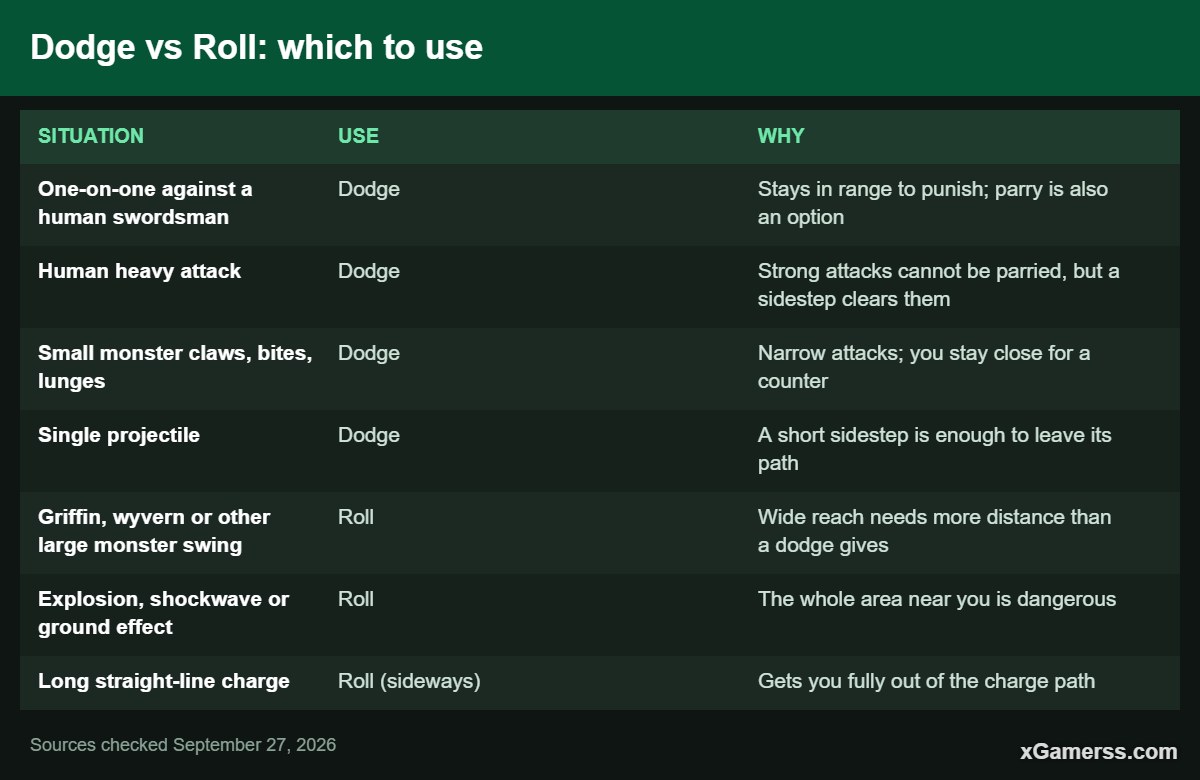
Dodge vs Roll: Situation Table
| Situation | Use | Why |
|---|---|---|
| One-on-one against a human swordsman | Dodge | Stays in range to punish; parry is also an option |
| Human heavy attack | Dodge | Strong attacks cannot be parried, but a sidestep clears them |
| Small monster claws, bites, lunges | Dodge | Narrow attacks; you stay close for a counter |
| Single projectile | Dodge | A short sidestep is enough to leave its path |
| Griffin, wyvern or other large monster swing | Roll | Wide reach needs more distance than a dodge gives |
| Explosion, shockwave or ground effect | Roll | The whole area near you is dangerous |
| Long straight-line charge | Roll (sideways) | Gets you fully out of the charge path |
| Surrounded by several enemies | Roll, then dodge | Break out once, then fight from the edge of the group |
| Low on stamina, need a Sign soon | Dodge | Rolling interrupts stamina regeneration |
Skills That Affect Dodging
In the Combat skill tree's Defense branch, Fleet Footed is the skill built around evasion. Its in-game description at rank 1 reads: "Damage from hits received while dodging is reduced by 20%," with the reduction growing at each of its five ranks, according to the Fextralife wiki. It also adds a small Adrenaline Point gain bonus.
Two practical notes:
- Fleet Footed reduces damage from hits you take while evading. It does not make a badly aimed dodge safe in every case: wghost81's script analysis notes it does not turn an undodgeable attack into a dodgeable one.
- Player comments on the Fextralife page suggest it is most noticeable when you are heavily outnumbered, where stray hits can still connect mid-evade.
Beyond Fleet Footed, most of what makes evasion safer is general defense: keeping Quen available, wearing armor that suits your build, and managing stamina. For a broader look at what to unlock first, see our best early-game skills in Witcher 3.
Common Dodge and Roll Mistakes
- Rolling everything. TheGamer's advice is blunt: "Don't Roll So Much. You're Not a Hedgehog." Constant rolling leaves you out of range and short on stamina.
- Dodging toward the attack. Because dodging is direction-based, stepping into a swing can still get you hit. Sidestep across it or away from it.
- Evading too early. If you dodge before the attack is committed, the enemy simply tracks you. Wait for the swing to start.
- Not punishing after a dodge. The dodge exists to create an opening. Follow it with a couple of fast attacks instead of backing off.
- Relying on blocking against big hits. Strong attacks cannot be parried, so evading is the answer. Our Witcher 3 blocking guide explains what blocking can and cannot handle.
- Rolling by accident on controller. Since roll shares a button with sprint and interact, a panicked tap in combat can send Geralt rolling. Be deliberate with that button.
If you are still getting comfortable with the combat system in general, our Witcher 3 combat tips for beginners puts dodging, parrying and Signs together into one routine.
Frequently Asked Questions
QIs dodge or roll better in The Witcher 3?
Dodge is better for most fights because it keeps you close enough to counter. Roll is better when an attack covers a wide area or a long distance, such as large monster swings, shockwaves and charges.
QDoes rolling use stamina in Witcher 3?
In the unmodded game, rolling does not spend stamina like a Sign does, but it interrupts stamina regeneration. Rolling repeatedly can leave you without enough stamina to cast Quen or Aard when you need it.
QHow do you dodge on PC in Witcher 3?
Press Left Alt with a direction key, or double-tap W, A, S or D. Space with a direction performs a roll. Both only work during combat.
QWhy do I still get hit when I dodge?
Dodging depends on the direction you move relative to the attack. Dodging toward the attacker, or too early, can still get you hit. Sidestep across or away from the swing, and roll instead if the attack covers a wide area.
QIs Fleet Footed worth taking?
It is the only Combat tree skill that directly targets dodging, reducing damage from hits taken while evading. It is most useful if you fight large groups or rely heavily on evasion instead of parrying.
Sources checked on September 27, 2026 against the Fextralife Witcher 3 wiki (Controls, Combat, Fleet Footed), Game8's Witcher 3 controls guide, TheGamer, ConsolePulse and wghost81's analysis of the vanilla combat scripts.
Kai Mercer covers game news, free games, release calendars and guides for xGamerss.
More from Kai Mercer →
Comments (0)
No comments yet. Be the first!
Sign in or create an account to earn karma — or comment as a guest.