
Best Graphics Cards for 4K Gaming in 2026: RTX 50 vs RX 9070 Picks
The best graphics cards for 4K gaming in 2026: RTX 5080, RTX 5070 Ti, RX 9070 XT, RX 9070 and RTX 5090 compared on VRAM, power, MSRP and DLSS/FSR.


In this article (0 sections)
Updated September 27, 2026. The best graphics cards for 4K gaming right now are still NVIDIA's RTX 50 series and AMD's Radeon RX 9070 series. No new gaming GPU generation has launched in 2026, the rumored RTX 50 Super refresh has not appeared, and Intel's current Arc desktop cards are aimed at 1440p. That makes this a question of which existing card fits your budget, your power supply and your tolerance for upscaling.
Quick answer
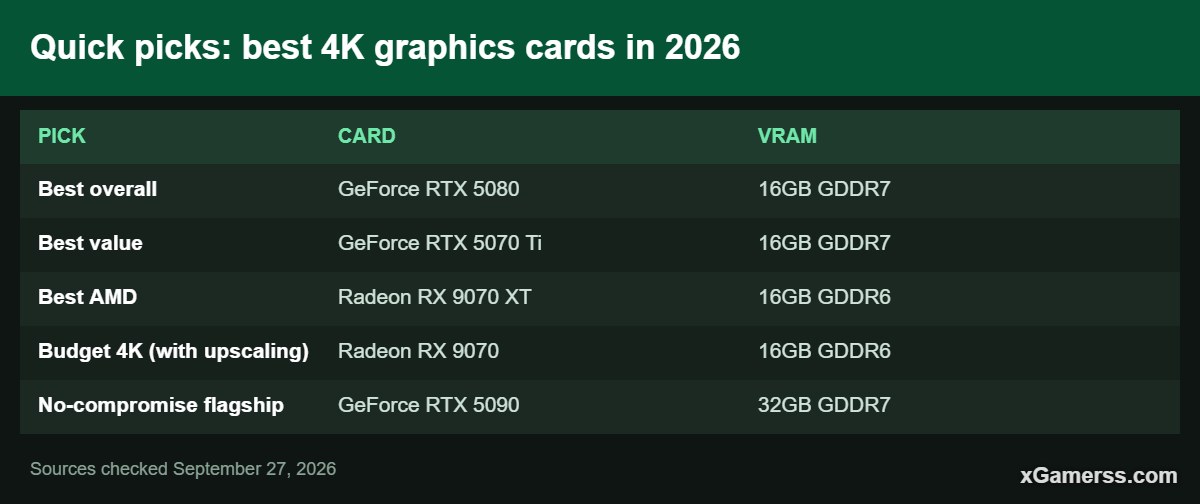
For most people building a 4K PC, the GeForce RTX 5080 (16GB, $999 MSRP) is the best balance of speed and features. The RTX 5070 Ti (16GB, $749 MSRP) is the best value, the Radeon RX 9070 XT (16GB, $599 MSRP) is the best AMD pick, and the Radeon RX 9070 (16GB, $549 MSRP) is the cheapest sensible entry into 4K if you lean on upscaling. The RTX 5090 is the only card for no-compromise 4K, at a price most buyers should skip.
Quick picks: best 4K graphics cards in 2026
Prices below are the launch MSRPs set by NVIDIA and AMD. Street prices have run well above MSRP for much of 2026 because of memory supply pressure, so treat these as reference points, not what you will necessarily pay at checkout.
| Pick | Card | VRAM | Board power | Recommended PSU | Launch MSRP |
|---|---|---|---|---|---|
| Best overall | GeForce RTX 5080 | 16GB GDDR7 | 360W | 850W | $999 |
| Best value | GeForce RTX 5070 Ti | 16GB GDDR7 | 300W | 750W | $749 |
| Best AMD | Radeon RX 9070 XT | 16GB GDDR6 | 304W | 750W | $599 |
| Budget 4K (with upscaling) | Radeon RX 9070 | 16GB GDDR6 | 220W | 650W | $549 |
| No-compromise flagship | GeForce RTX 5090 | 32GB GDDR7 | 575W | 1000W | $1,999 |
Board power and PSU figures come from NVIDIA's and AMD's official spec pages: NVIDIA lists Total Graphics Power and "Required System Power," AMD lists Total Board Power and a minimum recommended PSU. Factory-overclocked partner cards can draw more than these reference numbers.
No new generation in 2026
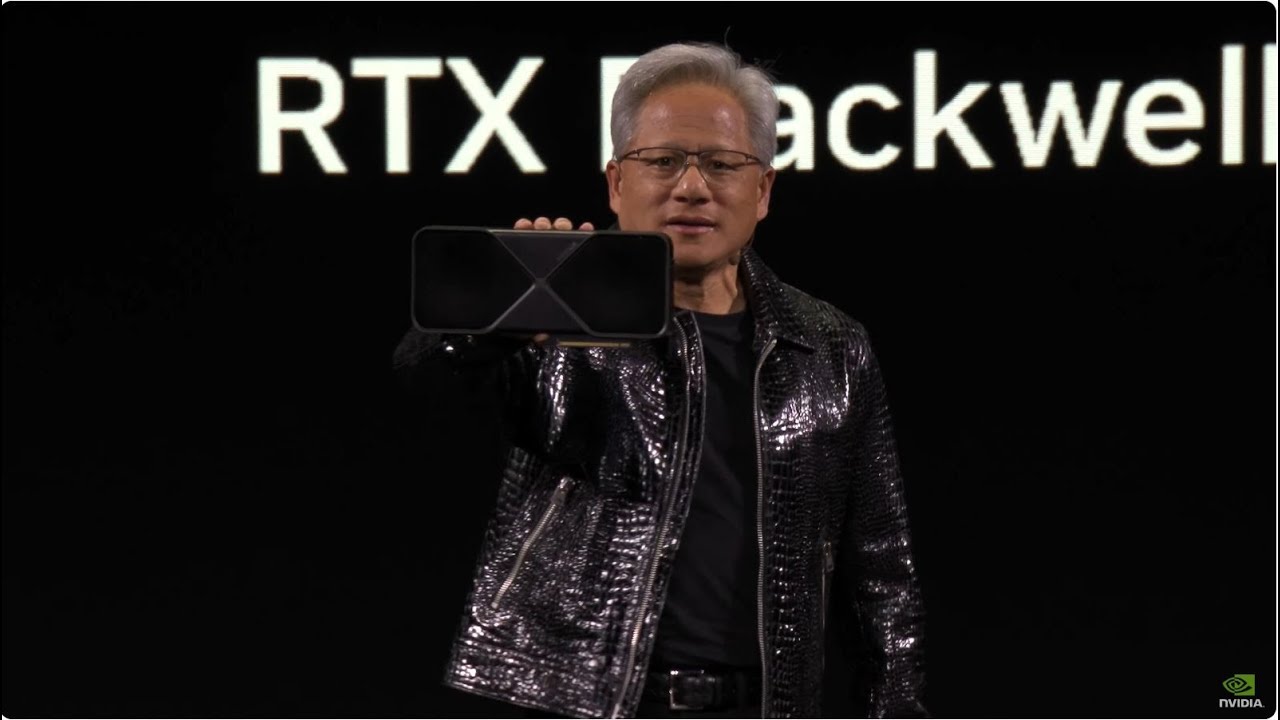
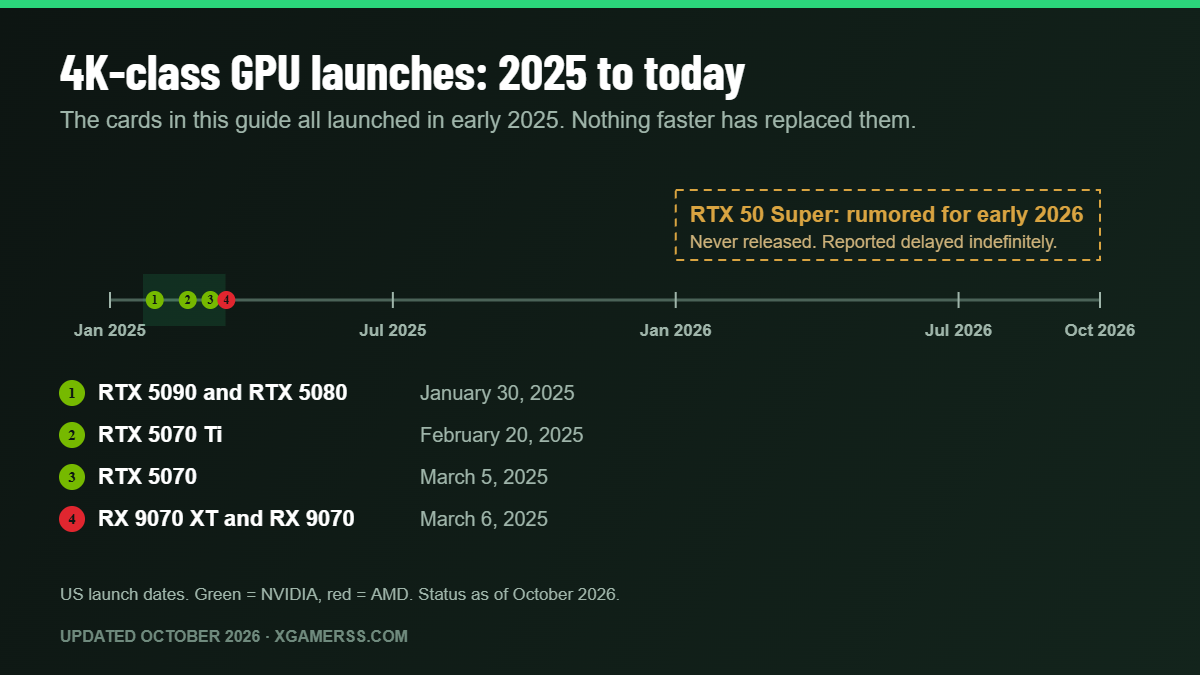
If you have been waiting for something new, the honest update is that the current lineup is the one you will be buying from this fall. The RTX 50 series (Blackwell) launched in early 2025 and AMD's RDNA 4 cards arrived in March 2025. Tom's Hardware's GPU buying guide, last updated July 30, 2026, notes that no entirely new gaming GPUs launched in 2026.
RTX 50 Super: treat it as off the table
An RTX 50 Super refresh with more VRAM was widely rumored for early 2026. It never arrived. TweakTown reported that NVIDIA told partners the series was "delayed indefinitely," and later reports tied to Gamescom 2026 claimed it had been cancelled outright, citing GDDR7 memory shortages. NVIDIA has not made a public statement either way, so this is still reporting rather than official confirmation. Either way, it is not a reason to hold off a purchase right now.
Prices are the real problem
Memory supply pressure pushed GPU prices up through 2026, and they are still climbing. In our October 9 check, the cheapest in-stock RTX 5070 Ti was $1,169.99 against its $749 MSRP, the RX 9070 XT was $814.99 against $599, and the RTX 5090 was about $6,886 against $1,999. See our store-by-store price comparison below before you buy.
Intel is not a 4K option this round
Intel's current desktop Arc B-series page lists the Arc B580 and B570, and Intel positions both for 1440p gaming. The long-rumored higher-end "B770" has not launched as a gaming card. Intel is a strong budget story, but not a 4K one.
4K Graphics Card Prices Right Now: Newegg vs Best Buy vs B&H (October 2026)
Launch MSRPs mean little in 2026, so we checked what these cards actually cost. On October 9, 2026 we looked up the cheapest new, in-stock model of each GPU at three of the biggest US PC hardware stores: Newegg, Best Buy and B&H Photo. Any brand counts, but we skipped open-box, refurbished and used listings. Newegg results include its marketplace sellers. Prices change daily, so treat this as a snapshot and check the store before you buy.
| GPU | Launch MSRP | Newegg | Best Buy | B&H Photo | Cheapest today |
|---|---|---|---|---|---|
| GeForce RTX 5090 | $1,999 | $6,886 | $8,045 | out of stock | $6,886 |
| GeForce RTX 5080 | $999 | $1,599.99 | $1,599.99 | $1,599.99 | $1,599.99 |
| GeForce RTX 5070 Ti | $749 | $1,169.99 | $1,189.99 | $1,199.99 | $1,169.99 |
| Radeon RX 9070 XT | $599 | $829.00 | $814.99 | out of stock | $814.99 |
| Radeon RX 9070 | $549 | $699.99 | not listed | out of stock | $699.99 |
| GeForce RTX 5070 (12GB) | $549 | $849.99 | $799.99 | $856.99 | $799.99 |
A few things stand out. The RTX 5080 was $1,599.99 at all three stores, which suggests that is the current going rate rather than a one-off markup. The RTX 5090 is the outlier: the cheapest in-stock card was nearly $6,900, about 3.4 times its $1,999 MSRP, and B&H had none in stock. AMD cards were the hardest to find: B&H listed every RX 9070 and RX 9070 XT as temporarily out of stock, and Best Buy's cheapest RX 9070 XT ($739.99) was sold out, so the $814.99 Gigabyte model was the cheapest one you could order there.
Best value for money at 4K
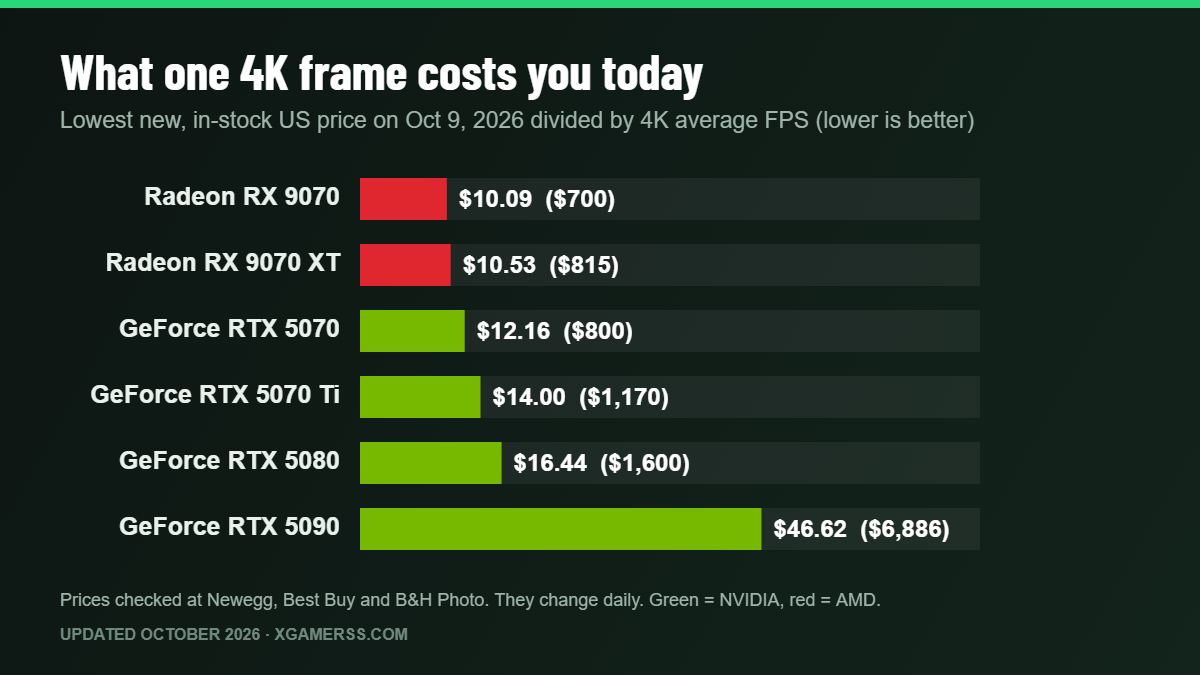
Price alone does not tell you which card is the best deal. To compare value, we divided each card's cheapest price by its 4K average frame rate from TechPowerUp's 25-game test suite (native 4K, maximum settings, no upscaling). The result is roughly what you pay for each frame per second.
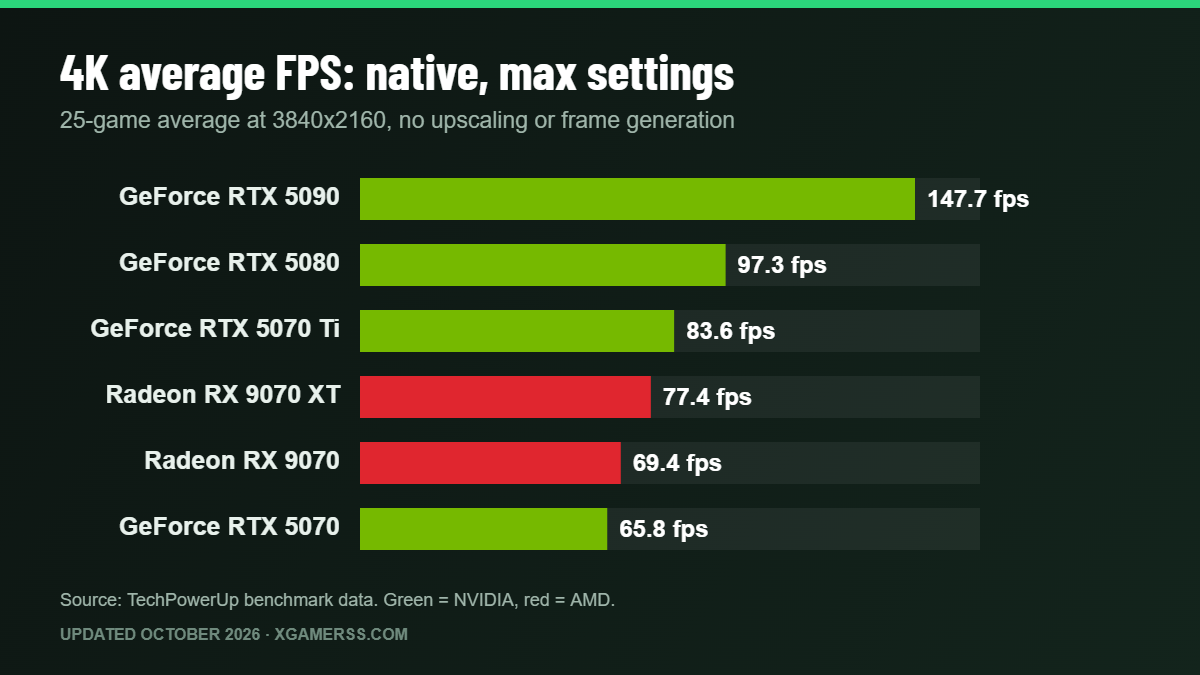
| GPU | 4K average FPS | Cheapest price | Cost per 4K frame | Above MSRP |
|---|---|---|---|---|
| Radeon RX 9070 | 69.4 | $699.99 | $10.09 | +28% |
| Radeon RX 9070 XT | 77.4 | $814.99 | $10.53 | +36% |
| GeForce RTX 5070 | 65.8 | $799.99 | $12.16 | +46% |
| GeForce RTX 5070 Ti | 83.6 | $1,169.99 | $14.00 | +56% |
| GeForce RTX 5080 | 97.3 | $1,599.99 | $16.44 | +60% |
| GeForce RTX 5090 | 147.7 | $6,886 | $46.62 | +244% |
Our verdict on value:
- Best value for most people: Radeon RX 9070 XT (about $815). It costs $10.53 per 4K frame, it has 16GB of VRAM, and its 36% markup over MSRP is the smallest of the fast cards. It is about 7% slower than the RTX 5070 Ti at native 4K while costing about $355 less.
- Cheapest per frame: Radeon RX 9070 (about $700). It is slightly cheaper per frame ($10.09), but it is around 10% slower than the XT and was in stock only at Newegg. At 4K you will lean on FSR upscaling in heavy games.
- Best NVIDIA value: RTX 5070 Ti (about $1,170). At $14.00 per frame it costs more than the AMD cards, but you get DLSS 4.5 with multi frame generation and stronger ray tracing. If you play path-traced games, that gap can be worth paying for.
- Skip for 4K: RTX 5070 (about $800). Its $12.16 per frame looks fine, but it has only 12GB of VRAM, below the 16GB we recommend for 4K. The RX 9070 XT costs about the same and is faster.
- RTX 5080 and RTX 5090: buy these only for maximum performance. At $16.44 and $46.62 per frame, they are the worst value on the list.
One more reason not to wait for AMD prices to drop: TechRadar reported a rumor that AMD plans to raise GPU prices by about 10% in the fourth quarter of 2026. AMD has not confirmed it.
Tips for buying a GPU at the best price
- Compare all three stores. In our check the same GPU was up to $57 cheaper at one store than another, and over $1,100 cheaper for the RTX 5090.
- Buy the cheapest model of the GPU you want. Basic models like the ASUS Prime, Gigabyte Windforce or PNY cards perform within a few percent of premium versions that cost hundreds more.
- Check who the seller is on Newegg. Marketplace sellers can have different return policies than Newegg itself.
- Use stock alerts for AMD cards. Many RX 9070 and RX 9070 XT models were out of stock, and the cheaper ones tend to sell out first.
GeForce RTX 5080: best overall for 4K
The RTX 5080 is the fastest card most people can realistically justify for a 4K build. It pairs 16GB of GDDR7 on a 256-bit bus with full access to NVIDIA's software stack, including DLSS 4.5 Super Resolution, Multi Frame Generation and the new DLSS 5 neural rendering feature.
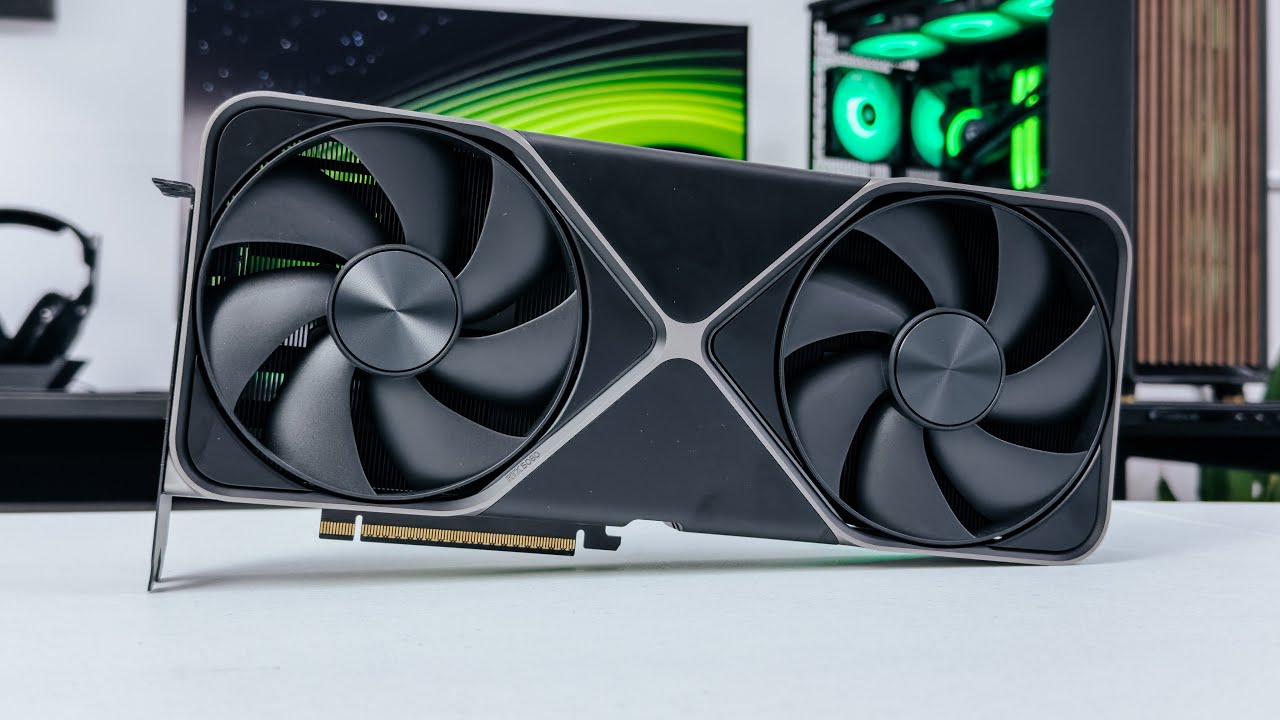
- Memory: 16GB GDDR7, 256-bit, 960 GB/s
- Power: 360W Total Graphics Power, 850W required system power
- Connectors: 3x 8-pin via adapter, or one 450W+ PCIe Gen 5 (12V-2x6) cable
- Outputs: 3x DisplayPort 2.1b, 1x HDMI 2.1b
- Launch MSRP: $999 (January 30, 2025)
Keep expectations grounded, though. Tom's Hardware's launch review found the RTX 5080 was 9% faster than the RTX 4080 Super at 4K ultra in rasterization and called the generational gain "relatively slim." If you already own an RTX 4080 or 4080 Super, this is not an upgrade worth paying for.

GeForce RTX 5070 Ti: best value for 4K
The RTX 5070 Ti is the card that makes 4K affordable without cutting corners on memory. It has the same 16GB of GDDR7 and 256-bit bus as the RTX 5080, which matters in texture-heavy games at high resolution.
- Memory: 16GB GDDR7, 256-bit
- Power: 300W Total Graphics Power, 750W required system power
- Connectors: 2x 8-pin, or one 300W+ PCIe Gen 5 cable
- Launch MSRP: $749 (February 2025)
Tom's Hardware reported that the 5070 Ti "averages just over 60 fps at 4K ultra" across its rasterization test suite, finished 14% ahead of the RTX 4070 Ti Super at 4K, and was "basically a tie" with AMD's last-generation RX 7900 XTX. That is solid native 4K performance, and DLSS gives it headroom in heavier ray-traced games.
The catch is price. In Tom's Hardware's July snapshot it was selling far above MSRP, which eats into its value lead. If the 5070 Ti is priced close to an RTX 5080 where you shop, the 5080 becomes the better buy.

Radeon RX 9070 XT: best AMD card for 4K
AMD did not build an ultra-high-end RDNA 4 card, so the RX 9070 XT is the top of the Radeon range. It is still a capable 4K card, especially at its MSRP, and its 16GB of VRAM matches the 5070 Ti and 5080.
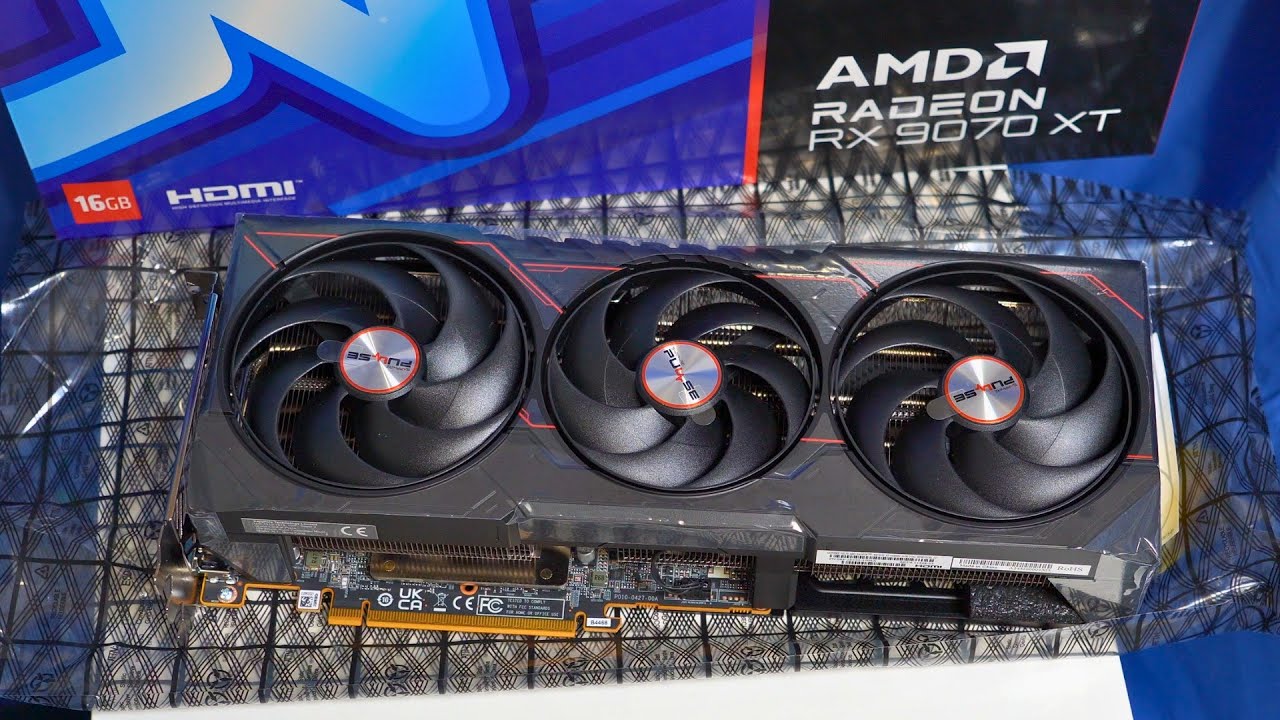
- Memory: 16GB GDDR6, 256-bit, 64MB Infinity Cache
- GPU: 64 compute units, 4,096 stream processors, boost up to 2,970 MHz
- Power: 304W Total Board Power, 750W minimum recommended PSU
- Outputs: DisplayPort 2.1a, HDMI 2.1b
- Launch MSRP: $599 (March 6, 2025, from board partners)
In its launch review, Tom's Hardware found the RX 9070 XT "only about 5% slower than the RTX 5070 Ti" while costing 20% less at MSRP, and gave it 4.5 stars as "an awesome value." Ray tracing improved significantly over previous Radeon generations, though NVIDIA still leads in the heaviest path-traced games.
Its most important 4K feature is FSR 4, AMD's machine-learning upscaler, now part of the FSR "Redstone" suite. The full Redstone package (upscaling, frame generation, Ray Regeneration and Radiance Caching) is supported only on RX 9000 series cards, according to AMD. Power connectors vary by partner model, so check the specific card against your PSU cables.
Who it is for: 4K players who want 16GB of VRAM at the lowest price, mostly play rasterized or lightly ray-traced games and are happy with AMD's software ecosystem.
Radeon RX 9070 (and RTX 5070): budget 4K with upscaling
Below roughly $600 at MSRP, native 4K at high settings in new games is not realistic. What you can get is a good 4K experience using upscaling from a lower internal resolution. For that job, we favor the RX 9070 over the RTX 5070 because of memory.
- RX 9070: 16GB GDDR6, 56 compute units, 220W board power, 650W PSU, 2x 8-pin, $549 MSRP
- RTX 5070: 12GB GDDR7, 250W TGP, 650W required system power, $549 MSRP
Tom's Hardware found the RX 9070 "faster than the RTX 5070, but not by that much," while using less power and offering more VRAM. Its RTX 5070 review said 4K "will typically need some upscaling help to hit smooth performance levels (60-ish FPS or more)," and called 12GB on a $550 card "definitely" inadequate.
The case for the RTX 5070 anyway is software. DLSS is supported in far more games than FSR 4, and DLSS 4.5 and DLSS 5 are RTX-only. If the games you play most support DLSS and not FSR 4, the 5070 can be the better experience despite the smaller memory pool.
GeForce RTX 5090: the no-compromise flagship
The RTX 5090 is the only consumer card that can realistically push maximum settings at 4K in the most demanding games, and it is the easy pick for high-refresh 4K monitors. It is also a card most gamers should not buy.
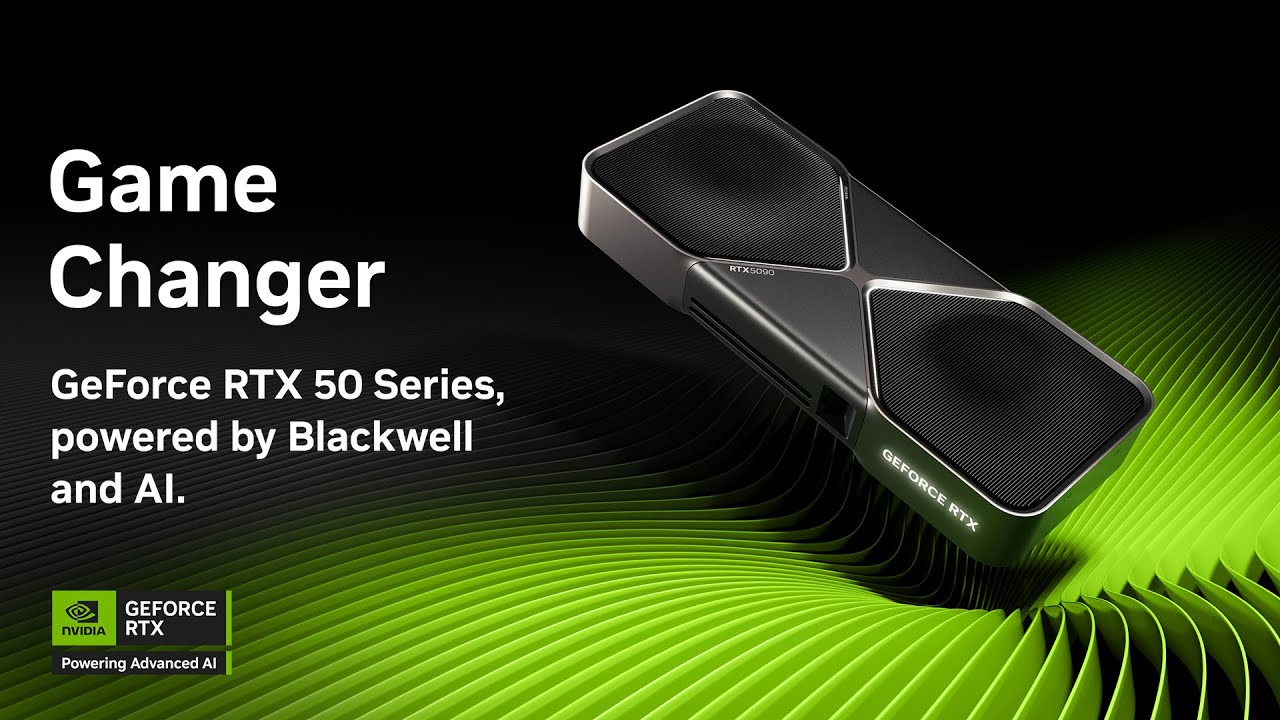
- Memory: 32GB GDDR7, 512-bit, 1,792 GB/s
- GPU: 21,760 CUDA cores, 2.41 GHz boost
- Power: 575W Total Graphics Power, 1000W required system power
- Connectors: 4x 8-pin via adapter, or one 600W PCIe Gen 5 cable
- Launch MSRP: $1,999 (January 30, 2025)
Tom's Hardware measured the RTX 5090 at 25% faster than the RTX 4090 across its 4K ultra rasterization suite, with individual games ranging from 6% to 43% faster. At 1080p and 1440p the lead shrank sharply, which is why the 5090 only makes sense for 4K and above.
The practical issues are cost and power. At roughly double its MSRP in mid-2026 street pricing, the 5090 costs more than a complete RTX 5080 gaming PC. It also needs a 1000W PSU and a case with good airflow. NVIDIA recommends a PCIe CEM 5.1 compliant power supply, and you should make sure the 16-pin connector is fully seated.

Upscaling and frame generation: what they actually do at 4K
NVIDIA DLSS 4.5 and DLSS 5
- DLSS 4.5 Super Resolution uses a second-generation transformer model and works on all GeForce RTX cards, though NVIDIA notes RTX 20 and 30 series cards take a bigger performance hit because they lack FP8 support.
- Multi Frame Generation 6X and Dynamic Multi Frame Generation are exclusive to the RTX 50 series and rolled out on March 31, 2026 via the NVIDIA app. Dynamic mode adjusts the frame multiplier based on performance and your monitor's refresh rate.
- DLSS 5 launched in September 2026 with NBA 2K27 as the first game. It is not an upscaler. NVIDIA describes it as "3D-Guided Neural Rendering" that adds lighting and material detail, as an optional feature developers enable alongside Super Resolution and frame generation. NVIDIA's launch post lists support for RTX 50 series GPUs.
AMD FSR "Redstone"
AMD's FSR suite now includes ML-based upscaling, frame generation, Ray Regeneration and Radiance Caching. All four require an RX 9000 series card. RX 7000 owners get the upscaler only. AMD lists over 300 games supporting FSR technologies overall, though that count includes older FSR versions. Reviewers generally agree the jump from FSR 3 to FSR 4 is large, with TechRadar summarizing it as a "night and day" improvement that still falls short of DLSS 4.
Generated frames are not real performance
Frame generation makes motion look smoother, but it does not make a game more responsive. In its DLSS 4 testing, Tom's Hardware suggested a base frame rate above about 40 fps before frame generation gives a decent result. Their conclusion: it takes "a good experience" and makes it "slightly better." Judge any card by its performance with upscaling alone, then treat frame generation as a bonus for high-refresh displays.
What to look for in a 4K graphics card
VRAM: 16GB is the sensible floor
4K textures and ray tracing consume a lot of memory. Every card we recommend for comfortable 4K has 16GB or more. A 12GB card like the RTX 5070 can work with upscaling, but reviewers have already flagged games where it runs short at high settings. Avoid 8GB cards entirely for 4K.
Power supply and connectors
- Use the vendor's PSU recommendation as a minimum, not a target, especially with a high-end CPU. NVIDIA bases its figures on a Ryzen 9 9950X system.
- For RTX 50 cards, a native 12V-2x6 (16-pin) cable from an ATX 3.x power supply is cleaner than the adapter. Fully seat the connector and avoid sharp bends near the plug.
- Radeon partner cards typically use standard 8-pin connectors, but the count varies by model.
Monitor, TV and cable
- 4K TVs: for 4K above 60Hz with VRR, you need an HDMI 2.1 port on the TV, and a certified Ultra High Speed HDMI cable. All the cards here have HDMI 2.1b.
- 4K monitors: DisplayPort is usually the better connection. The RTX 50 series supports DisplayPort 2.1b and up to 4K at 480Hz with DSC. The RX 9070 series supports DisplayPort 2.1a.
- Refresh rate: a 4K 144Hz or 240Hz monitor only pays off if your card can feed it. Frame generation is most useful here.
If you are building a PC for a specific upcoming release, check its official requirements first. Our Modern Warfare 4 PC specs guide and the October 2026 release calendar are good starting points, and the Witcher 3 hub lists PC requirements ahead of the free Witcher 3 Remastered upgrade.
Frequently Asked Questions
QWhat is the cheapest graphics card that can run 4K?
Among current-generation cards, the Radeon RX 9070 and GeForce RTX 5070 (both $549 MSRP) are the practical entry point, but both need upscaling for smooth 4K in demanding games. The RX 9070 has 16GB of VRAM versus 12GB on the RTX 5070.
QShould I wait for the RTX 50 Super or RTX 60 series?
Multiple outlets have reported that the RTX 50 Super was delayed indefinitely or cancelled because of memory shortages, and NVIDIA has announced no RTX 60 launch date. If you need a card now, waiting for unannounced hardware is a gamble.
QIs 16GB of VRAM enough for 4K gaming?
Yes, for current games 16GB is the comfortable standard at 4K, and it is what the RTX 5080, RTX 5070 Ti, RX 9070 XT and RX 9070 all use. Only the RTX 5090 goes beyond that, with 32GB.
QWhat power supply do I need for an RTX 5080 or RTX 5090?
NVIDIA lists 850W required system power for the RTX 5080 and 1000W for the RTX 5090, based on a Ryzen 9 9950X system. A quality ATX 3.x unit with a native 16-pin cable is the cleanest option.
QIs DLSS better than FSR 4 for 4K?
Reviewers generally rate DLSS image quality ahead of FSR 4, and DLSS is supported in more games. FSR 4 closed much of the gap versus FSR 3, though, and it only runs fully on RX 9000 series cards.
QDoes Intel make a 4K gaming graphics card?
Not currently. Intel's desktop Arc B580 and B570 are positioned for 1440p, and the rumored higher-end Arc B770 has not launched as a gaming card.
Bottom line: The 4K GPU market in late 2026 is stable in hardware and messy in pricing. Buy the RTX 5080 if you want the best all-round 4K card without flagship excess, the RTX 5070 Ti if you can find it near MSRP, or the RX 9070 XT if you want 16GB of VRAM for the least money. Leave the RTX 5090 to buyers for whom price is no object.
Sources checked on September 27, 2026 against NVIDIA's official GeForce RTX 50 series spec pages and GeForce News, AMD's Radeon RX 9070 series product pages and FSR technology page, Intel's Arc B-series page, and reviews and buying guides from Tom's Hardware. Store prices were checked at Newegg, Best Buy and B&H Photo on October 9, 2026. 4K frame rates come from TechPowerUp's graphics card reviews.
Kai Mercer covers game news, free games, release calendars and guides for xGamerss.
More from Kai Mercer →
Comments (0)
No comments yet. Be the first!
Sign in or create an account to earn karma — or comment as a guest.